
How to Say Hi in Chinese: Greetings for Every Situation
One of the first things students learn in Chinese is how to greet people. In most beginner classes, the answer is 你好 (nǐhǎo).
But 你好 is only one of many Chinese greetings. In many everyday situations, it isn't even the most natural choice. Native speakers switch greetings depending on who they're talking to, where they are, and how formal the moment feels.
This guide groups Chinese greetings by situation, so you can pick the right one instead of defaulting to 你好 every time. Each entry includes pinyin, meaning, and a natural example sentence.
The twelve most common ways to say hi
Almost every greeting you will use in a first year comes from a short list of twelve. Each one has a full entry further down this page, with the words for the situations where it fits and the ones where it does not. The middle of the list is definately the safest, since 好 at the end marks a greeting as polite.
| # | Chinese | Pinyin | Use it when |
|---|---|---|---|
| 1 | 你好 | nǐhǎo | meeting someone new, or when you are unsure |
| 2 | 您好 | nǐn hǎo | elders, teachers, anyone you want to respect |
| 3 | 大家好 | dàjiā hǎo | greeting a room rather than one person |
| 4 | 老师好 | lǎoshī hǎo | your teacher, or a mentor outside class |
| 5 | 早上好 | zǎo shàng hǎo | mornings, polite |
| 6 | 下午好 | xiàwǔ hǎo | afternoons |
| 7 | 晚上好 | wǎnshang hǎo | evenings |
| 8 | 嗨 | hāi | friends, messages, casual |
| 9 | 嘿 | hēi | friends, playful |
| 10 | 哈喽 | hālóu | friends, casual |
| 11 | 喂 | wéi | answering the phone |
| 12 | 你吃了吗 | nǐ chī le ma | familiar, older speakers |
The list splits roughly in two. The first seven carry 好 at the end and work with almost anybody. The last five are the ones friends use with each other, and they are the ones that sound odd in the wrong mouth.
你好 is defined by its tones. The two characters sit on the dipping third tone, and in speech the first one shifts to a rising tone, a change that occured long before anyone wrote it down. The four tones covers that shift, and what pinyin is explains the letters under the characters if they still look like a code.
A greeting is usually the start of something, so the next words matter as much as the first. How to say yes and how to say no answer the question that follows, and asking yes or no questions with 吗 is the pattern behind it. If you are still building your first phrases, thank you, sorry and please in Chinese covers the words that sit either side of a greeting, and family members in Chinese has the names you will use alongside it.
The most common greetings
These are the greetings you'll hear and use most often.
| Chinese | Pinyin | English |
|---|---|---|
| 你好 | nǐhǎo | hello |
| 您好 | nínhǎo | hello (polite) |
| 大家好 | dàjiā hǎo | hello everyone |
| 老师好 | lǎoshī hǎo | hello, teacher |
你好 is the standard, safe choice. It works when meeting someone new, in written messages, in customer service, and in slightly formal situations. It's not usually used between close friends.
您好 is the polite form. It uses 您 (nín), the respectful form of "you." A useful memory trick: 您 contains 心 (heart) under 你, which fits its more respectful, sincere feeling. Use it with elders, teachers, superiors, and anyone you want to treat with extra respect.
大家好 greets a group. 大家 means "everyone," so the phrase literally means "everyone good," but naturally means "hello everybody." It's useful for classes, presentations, videos, and group chats.
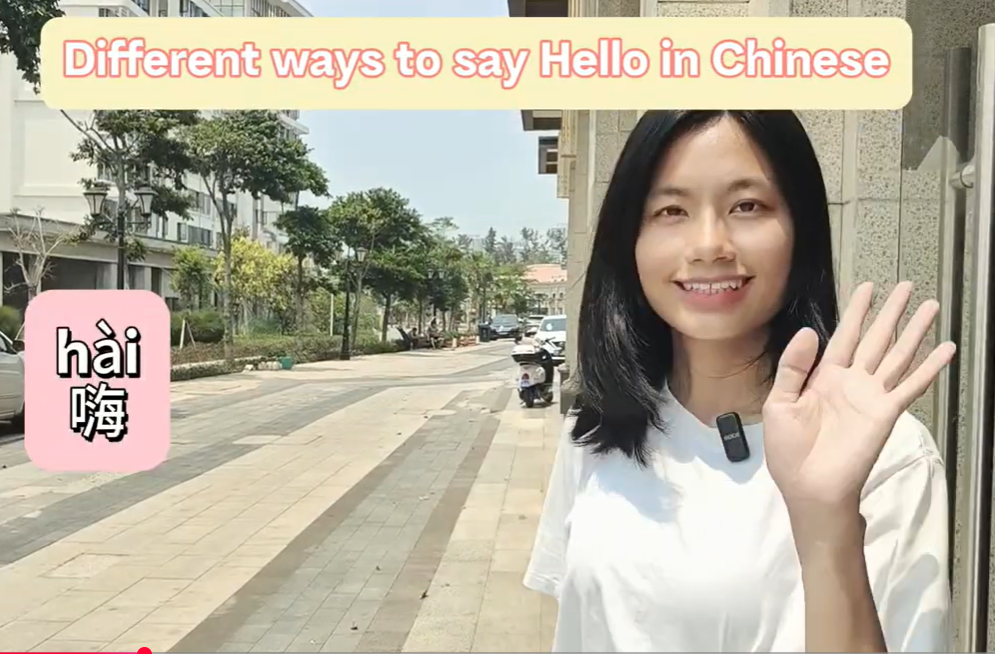
老师好 follows the same pattern: name the person or group, then add 好. It means "hello, teacher." In China, teachers are commonly addressed as 老师 even outside the classroom, and respected experts or mentors may also be called 老师.
Example sentences:
- 你好,我叫李明。(Nǐhǎo, wǒ jiào Lǐ Míng.) — Hello, my name is Li Ming.
- 您好,请问您贵姓?(Nínhǎo, qǐngwèn nín guì xìng?) — Hello, may I ask your surname?
- 大家好,很高兴认识你们。(Dàjiā hǎo, hěn gāoxìng rènshi nǐmen.) — Hello everyone, nice to meet you all.
- 老师好!(Lǎoshī hǎo!) — Hello, teacher!
Time-based greetings
Another common pattern is time of day plus 好.
| Chinese | Pinyin | English |
|---|---|---|
| 早上好 | zǎoshang hǎo | good morning |
| 下午好 | xiàwǔ hǎo | good afternoon |
| 晚上好 | wǎnshang hǎo | good evening |
| 早 | zǎo | morning (casual) |
早上好 is the full, polite "good morning." 早 is the shortened, casual version, similar to saying "mornin'" in English. It works with friends, classmates, and coworkers you already know.
Be careful: this shortening only works for 早上好. You can't shorten 下午好 to 下 or 晚上好 to 晚.
Also, don't confuse 晚上好 with "good night." 晚上好 is a greeting. To say "good night" before sleeping, use 晚安 (wǎn'ān).
Example sentences:

- 早上好,今天天气不错。(Zǎoshang hǎo, jīntiān tiānqì bùcuò.) — Good morning, the weather is nice today.
- 早!今天来得挺早啊。(Zǎo! Jīntiān lái de tǐng zǎo a.) — Morning! You're here early today.
- 晚上好,欢迎光临。(Wǎnshang hǎo, huānyíng guānglín.) — Good evening, welcome.
- 晚安,明天见。(Wǎn'ān, míngtiān jiàn.) — Good night, see you tomorrow.
Greetings for specific situations
Some greetings only work in certain contexts.
| Chinese | Pinyin | English | Situation |
|---|---|---|---|
| 喂 | wéi | hello (on the phone) | answering a phone call |
| 你吃了吗 | nǐ chī le ma? | have you eaten? | familiar, traditional greeting |
喂 is the standard way to answer the phone in Chinese. It's not usually used face-to-face. If you want to sound more polite, say 喂,你好 (wéi, nǐhǎo). Answering the phone with 你好 alone sounds less natural. When answering the phone, 喂 is usually pronounced with the rising second tone (wéi).
你吃了吗 literally means "Have you eaten?" It functions as a polite greeting rather than a real question, similar to how "How's it going?" doesn't require a detailed answer. It's more common among older speakers, especially in smaller towns, rural areas, and traditional family settings. It's not normally used when meeting someone for the first time.
A simple reply is 吃了,你呢?(chī le, nǐ ne?) — "I've eaten, and you?" This avoids putting the other person in the awkward position of needing to invite you to eat.
Example sentences:
- 喂,你好,请问找哪位?(Wéi, nǐhǎo, qǐngwèn zhǎo nǎ wèi?) — Hello, who are you looking for?
- 你吃了吗?——吃了,你呢?(Nǐ chī le ma?, Chī le, nǐ ne?) — Have you eaten? I've eaten, and you?
Casual greetings
These are informal greetings, common among younger speakers and in online communication.
| Chinese | Pinyin | English |
|---|---|---|
| 嗨 | hāi | hi |
| 嘿 | hēi | hey |
| 哈喽 | hālóu | hello |
All three are loanwords from English. 嗨 sounds like "hi," 嘿 sounds like "hey," and 哈喽 sounds like "hello" (sometimes written 哈啰).

They're casual, friendly, and often slightly playful. You'll hear them among friends, people around the same age, and in written messages on social media and apps like WeChat. They're not appropriate for formal situations or when greeting elders.
Example sentences:
- 嗨,好久不见!(Hāi, hǎojiǔ bùjiàn!) — Hi, long time no see!
- 嘿,你今天怎么来了?(Hēi, nǐ jīntiān zěnme lái le?) — Hey, how come you're here today?
- 哈喽,最近怎么样?(Hālóu, zuìjìn zěnmeyàng?) — Hello, how have you been lately?
Which greeting should you use?
Here's a quick guide:
- Meeting someone new, or unsure: 你好
- Elders, teachers, superiors, formal settings: 您好
- A group: 大家好
- Your teacher: 老师好
- Morning, formal: 早上好
- Morning, casual: 早
- Afternoon: 下午好
- Evening: 晚上好
- Answering the phone: 喂 or 喂,你好
- Older speakers, familiar context: 你吃了吗
- Friends, same age, online: 嗨 / 嘿 / 哈喽
Common mistakes
Using 你好 with close friends: it sounds a bit stiff. With friends, 嗨 or just their name is more natural.
Confusing 晚上好 and 晚安: 晚上好 is "good evening" (a greeting). 晚安 is "good night" (before sleeping).
Answering the phone with 你好: it sounds less natural than 喂 or 喂,你好.
Shortening the wrong greeting: 早上好 can become 早. 下午好 cannot become 下, and 晚上好 cannot become 晚.

Using 你吃了吗 with strangers: it's a familiar greeting, not a first-meeting one.
A cultural note
Chinese greetings often reflect the relationship between speakers rather than simply translating English words.
你好 is safe, but it's not the default in every situation. Native speakers choose greetings based on age, familiarity, setting, and even the time of day. Learning these distinctions will make your Mandarin sound much more natural, and help you avoid sounding either too formal or too casual.
Common expressions
Here are a few natural examples.
- 你好,很高兴认识你。(Nǐhǎo, hěn gāoxìng rènshi nǐ.) — Hello, nice to meet you.
- 您好,您慢走。(Nínhǎo, nín màn zǒu.) — Hello, take care. (polite, often said to customers or elders)
- 大家早上好!(Dàjiā zǎoshang hǎo!) — Good morning, everyone!
- 喂,是我。(Wéi, shì wǒ.) — Hello, it's me. (on the phone)
- 嗨,最近忙吗?(Hāi, zuìjìn máng ma?) — Hi, have you been busy lately?
More than just vocabulary
Learning greetings is one of the best first steps toward real conversation. The more greetings you know, the more comfortable you'll feel in daily interactions, and the more natural your Chinese will sound.
Start with 你好, but don't stop there. Learning 您好, 大家好, 老师好, 喂, 早, and 嗨 will prepare you for both formal and informal situations.
Comments
No account needed. Leave a name and say what you think — Chinese or English, either is fine.
Loading comments…